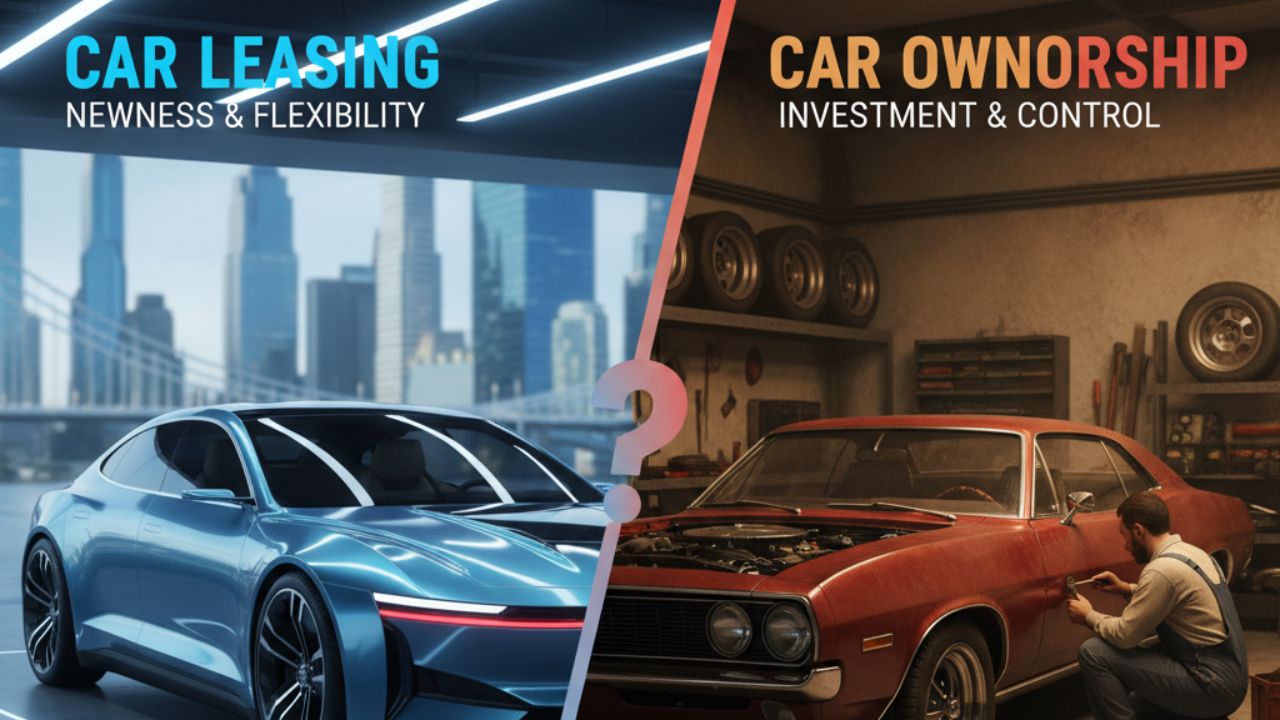
Walking into a car dealership often triggers a familiar wave of anxiety. You know what vehicle you want, but the payment structure presents a major financial crossroads. Should you lease the car and enjoy a lower monthly payment, or buy it outright to build equity over time?
This decision impacts your monthly budget, your long-term wealth, and your daily driving habits. Cars are depreciating assets, meaning they lose value the second you drive them off the lot. Because of this, the financial mechanics of acquiring a vehicle are fundamentally different from buying a house or investing in stocks.
Choosing between leasing and buying is rarely a one-size-fits-all scenario. Your choice depends heavily on your lifestyle, your commute, and your financial goals. Some drivers prioritize having the latest safety technology and a warranty that covers every mechanical hiccup. Others want the financial freedom of a title in their name and no car payment after five years.
This comprehensive guide breaks down the true costs, benefits, and hidden drawbacks of both leasing and buying. By examining the short-term cash flow and the long-term wealth implications, you will gain the clarity needed to make a financially sound decision before you sign on the dotted line.
The Reality of Leasing a Car
Leasing a vehicle is essentially a long-term rental agreement. You pay the dealership for the vehicle’s depreciation during the lease term, plus interest and fees, rather than the total purchase price. After typically two to four years, you return the car to the dealership.
Pros of Leasing
Lower monthly payments
Because you are only paying for the vehicle’s depreciation during the lease term, your monthly payments will almost always be lower than if you were financing the entire purchase price of that same car. This allows you to drive a more expensive, premium vehicle for a fraction of the traditional cost.
Drive new cars more often
Leasing operates on short cycles. Every few years, you get to hand over the keys and upgrade to a brand-new model. This means you consistently benefit from the newest safety features, improved fuel efficiency, and upgraded entertainment technology.
Warranty coverage
Most lease terms last three years or less, which conveniently aligns with the manufacturer’s bumper-to-bumper warranty. If the navigation system fails or the transmission acts up, the dealership handles the repairs at no cost to you. Routine maintenance like oil changes is sometimes included in the lease agreement as well.
Tax advantages for businesses
If you own a business or work as an independent contractor, leasing can offer significant tax deductions. You can often write off a portion of your lease payments as a business expense, depending on how much you use the vehicle for work purposes.
Cons of Leasing
No ownership equity
When you make a lease payment, you are paying for the use of the vehicle. At the end of the three-year term, you return the car and walk away with nothing. You have no equity to use as a trade-in for your next vehicle.
Mileage restrictions
Lease agreements come with strict annual mileage caps, usually ranging from 10,000 to 15,000 miles per year. If you exceed this limit, the leasing company will charge you a penalty fee for every additional mile driven. These fees can quickly add up to thousands of dollars when you turn the car in.
Wear and tear charges
Leasing companies expect the car to be returned in excellent condition. While they allow for normal wear, anything beyond minor scratches or typical tire usage will result in steep penalty charges. Spilled coffee stains, door dings, or scraped alloy wheels will come directly out of your pocket.
Continuous payments
If you choose to lease a car for your entire driving life, you will always have a car payment. You never reach a point where the vehicle is paid off and you can redirect that monthly cash flow toward savings or investments.
The Mechanics of Buying a Car
Buying a car means you are paying for the entire cost of the vehicle, usually through an auto loan provided by a bank or credit union. Once you make the final payment, you receive the title and own the asset free and clear.
Pros of Buying
Ownership and equity
The most significant financial advantage of buying is that every payment builds equity. Once the loan is paid off, the vehicle is entirely yours. Even though the car will have depreciated, it still holds a cash value that adds to your net worth.
No mileage limits
When you own the car, you can drive it across the country as many times as you want. There are no leasing companies tracking your odometer or charging you penalty fees for taking a long road trip.
Customization
Ownership gives you total control over the vehicle. You can upgrade the sound system, tint the windows, add a tow hitch, or change the paint color. With a lease, any unauthorized modifications violate the contract.
Sell or trade in anytime
If your financial situation changes or you simply want a different vehicle, you have the flexibility to sell the car or trade it in at any time. You are not locked into a fixed lease term with heavy early termination fees.
Cons of Buying
Higher monthly payments
Because you are financing the entire purchase price of the vehicle, your monthly loan payments will be noticeably higher than lease payments for the exact same car.
Depreciation
New cars lose a massive portion of their value in the first few years of ownership. If you buy a new car and try to sell it three years later, you will absorb the full financial hit of that steep depreciation curve.
Maintenance costs
Once the manufacturer’s warranty expires, you are entirely responsible for all mechanical failures. Replacing a transmission or fixing a modern car’s complex computer system can cost thousands of dollars out of pocket.
Larger down payment
Lenders typically require a substantial down payment to secure a favorable interest rate and keep your monthly payments manageable. Coming up with 10% to 20% of a car’s purchase price requires significant upfront cash.
Financial Analysis: Breaking Down the Numbers
To truly determine which option is financially smarter, you have to look beyond the monthly payment and examine the total cost over time.
Cost Comparison Over 3 to 5 Years
Let us look at a standard 36-month timeline. The person leasing a $35,000 car might put down $2,000 and pay $400 a month. Over three years, they spend $16,400. At the end of the term, they return the car and have zero equity.
The person buying the same $35,000 car might put down $5,000 and pay $600 a month on a five-year loan. Over those first three years, they spend $26,600. However, they now have substantial equity in the vehicle. If they sell the car, they can recoup a large portion of that money, making the true cost of ownership highly competitive with the lease.
Impact on Long-Term Wealth
The financial math shifts dramatically in favor of buying if you keep the car for a decade. A buyer who pays off a five-year loan will enjoy five subsequent years of driving without a car payment. That $600 a month can now be funneled into a retirement account or used to pay down a mortgage.
A continuous leaser, on the other hand, will fund back-to-back three-year leases for that same decade. They will always have a monthly payment, draining cash flow that could otherwise be used to build long-term wealth. Financially speaking, buying and holding a vehicle for 8 to 10 years is universally recognized as the most cost-effective way to drive.
When to Lease vs. When to Buy
Your decision ultimately comes down to your personal driving habits, your cash flow, and your psychological comfort with vehicle ownership.
You Should Lease If…
You prioritize driving a new vehicle with the latest technology and safety features every few years. Leasing is highly beneficial for people with short commutes who know they will comfortably stay under the 10,000 to 12,000 annual mileage limits. Furthermore, if you own a business and can utilize the vehicle for tax write-offs, the financial benefits of leasing become highly attractive. It is also an excellent option if you want to keep your monthly expenses as low as possible while still driving a reliable, under-warranty vehicle.
You Should Buy If…
You view a car as a long-term utility rather than a short-term luxury. Buying is essential for drivers who have long commutes, take frequent road trips, or rack up heavy mileage. It is the smarter choice for people who take good care of their vehicles and plan to keep them well beyond the payoff date. If your ultimate financial goal is to eliminate monthly debts and build equity, purchasing a car is the clear winner.
Hybrid Options to Consider
If neither traditional leasing nor buying a brand-new car appeals to you, the automotive market offers alternative routes.
Certified Pre-Owned (CPO) Vehicles
Purchasing a CPO vehicle offers an excellent middle ground. You bypass the steepest part of the depreciation curve by buying a car that is two to three years old. However, because it is certified by the manufacturer, it comes with a rigorous inspection and an extended warranty that provides peace of mind similar to a new car lease.
Rent-to-Own and Lease Buyouts
If you lease a vehicle and absolutely fall in love with it, you can execute a lease buyout at the end of your term. The leasing company sets a residual value at the beginning of your contract. If the car holds its value well, buying it at the end of the lease can be a financially sound way to transition from renting to owning a vehicle you already know and trust.
Making the Right Drive for Your Wallet
The debate between leasing and buying a car does not have a single correct answer. Leasing offers lower monthly payments, the thrill of a new car every few years, and freedom from stressful repair bills. Buying demands a higher initial investment but rewards you with equity, unrestricted driving, and the eventual relief of a payment-free lifestyle.
To make the best choice, calculate your annual mileage, evaluate your monthly budget, and define your long-term financial goals. Take the time to request quotes for both options at the dealership. Run the numbers for your specific situation, and you will drive off the lot confident that your decision aligns perfectly with your financial future.
